From case pipeline to funder-ready portfolio.
Import existing matters. Profile the book. Export a structured portfolio brief for funder review.
Single cases get ratings. Portfolios get profiles.
Start with the pipeline you already have.
Import your firm’s case tracker by spreadsheet, or pull in cases already rated on CaseFin. CaseFin maps the structure, normalizes the data, and preserves each case’s Rating detail, so the portfolio inherits real underwriting depth—not just summary rows.
One portfolio. Multiple sources. No re-entry.

Underwrite the book, not just the cases.
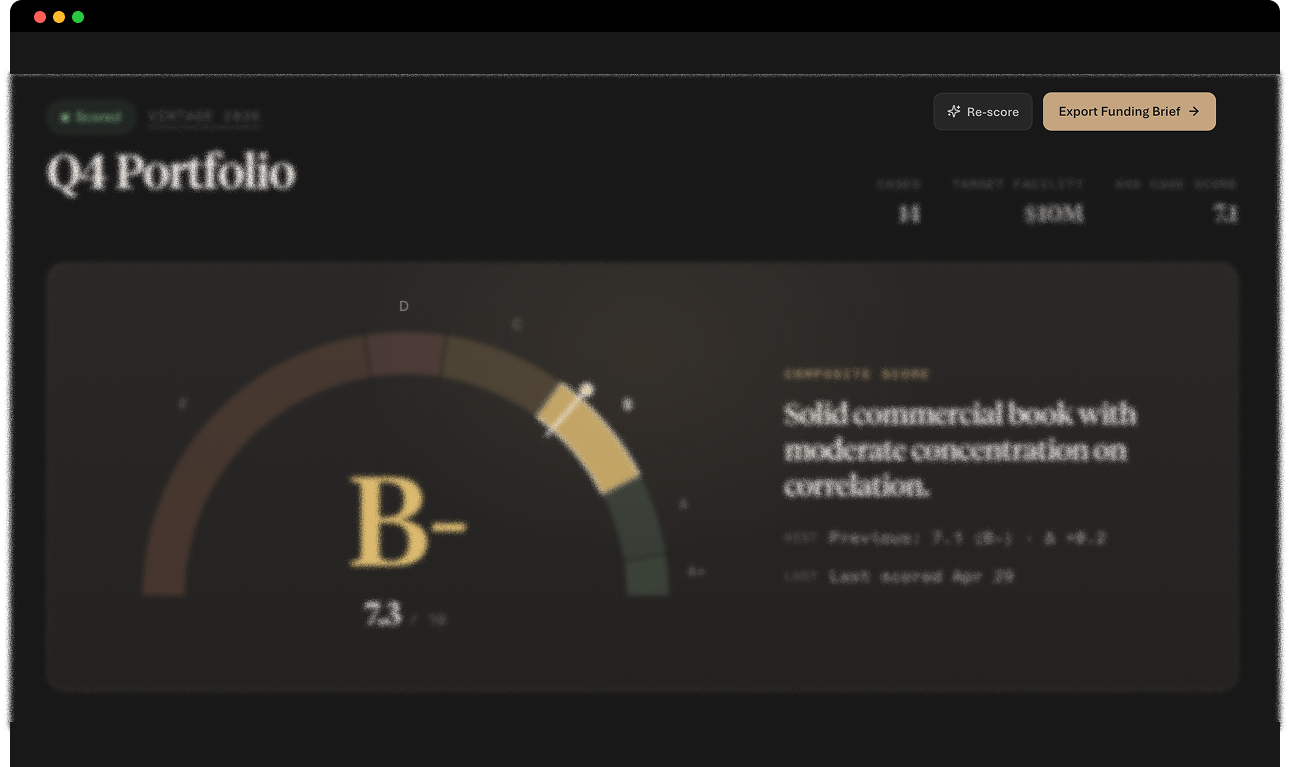
CaseFin profiles the portfolio across four construction dimensions: Constituent Case Quality, Diversification, Correlation Independence, and Capital Efficiency. Each dimension is published and traceable back to case-level evidence — the structural picture of the book, not an average of individual cases.
A profile of the structure, not the sum of cases.
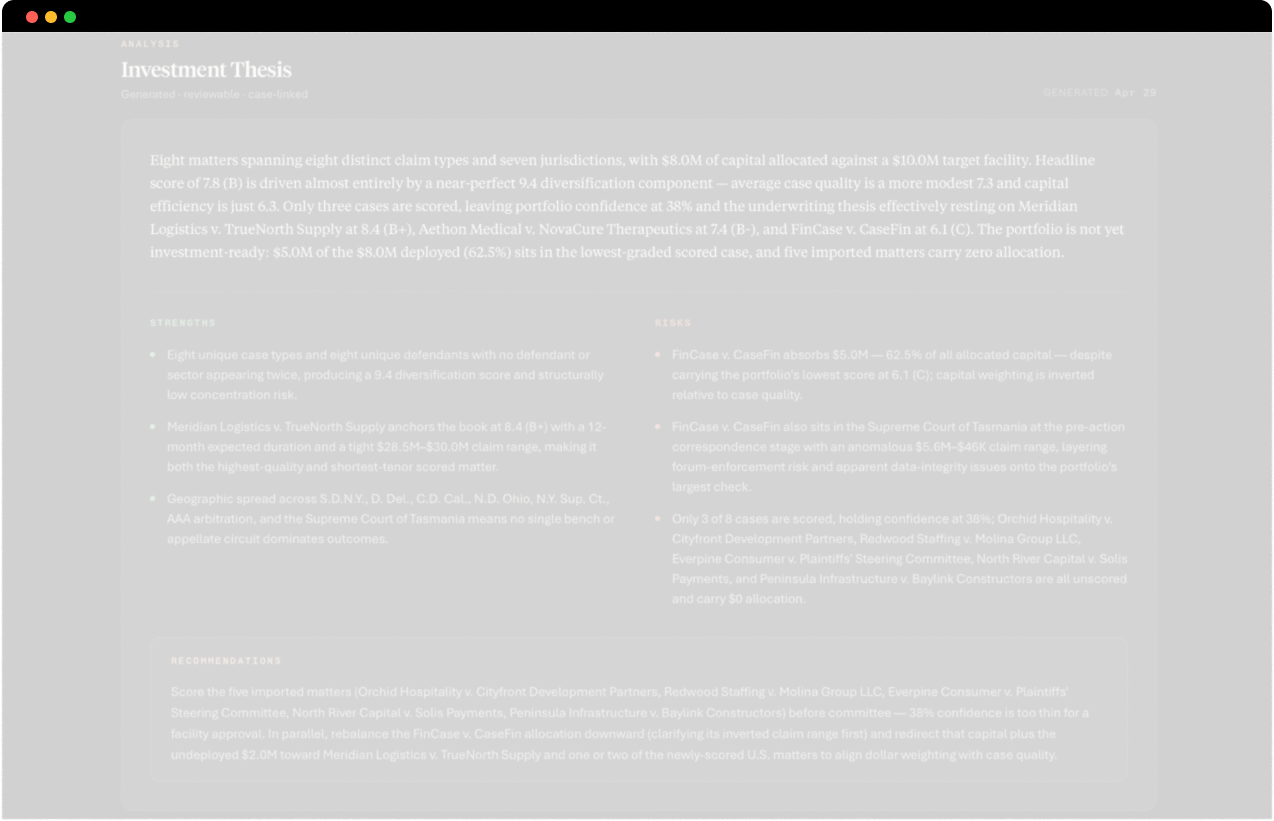
Turn the book into an investment thesis.
AI-generated investment thesis grounded in your actual portfolio composition. Concentration risk surfaced by dimension. Deployment timeline modeled quarter by quarter. Strengths and risks that reference specific cases, not generic observations.
Portfolio Confidence reports how much of the book has been individually underwritten, making the analytical depth itself transparent.
Investment thesis, written from your data.
One document. Every funder conversation.
The Portfolio Funding Brief packages everything into a single structured PDF: thesis, analytics, deployment timeline, constituent case summaries, methodology. Standardized to the same methodology as the single case brief. No bespoke decks. No per-meeting reformatting.
One brief. Every facility.
A portfolio is only as disciplined as the cases it contains.
Four construction dimensions.
CaseFin describes portfolios in four construction dimensions — Constituent Case Quality, Diversification, Correlation Independence, and Capital Efficiency — so counsel and funders can see what’s in the book before the term-sheet conversation. No single score collapses a litigation portfolio into one number. The dimensions are the credible artifact. Each one is published, reviewable, and traceable back to case-level evidence; Constituent Case Quality rolls up the individual CaseFin Ratings, and the three construction dimensions add what only exists at the book level.
- Constituent Case Quality50%
The foundation. Each case’s CaseFin Rating (Case Strength × Funding Readiness across eight factors) rolls up into this dimension. A portfolio of weak cases shapes the Profile regardless of how the book is constructed around them.
- Diversification25%
Distribution across five axes: case type, jurisdiction, defendant, duration, and claim size. Concentration on any single axis registers as a Profile weakness.
- Correlation Independence15%
Share of cases that do not sit in any correlation pair. Shared defendants, overlapping legal theories, and clustered jurisdictions reduce independence; higher = more independent matters in the book.
- Capital Efficiency10%
How well allocated funding maps to the target facility size and the deployment timeline across the facility term.
Start with a case. Build toward a portfolio.
Submit, rate, and export individual cases as standalone funding briefs. Then roll rated cases into a portfolio when you’re ready to present a broader facility.
See Single Case